Marketing automation has already made life easier for businesses. Emails can be triggered automatically, leads can move through CRM pipelines, reports can be generated, and follow-ups can happen without constant manual work.
But most automation still follows fixed instructions.
If this happens, do that.
AI agents are changing that model. Instead of only following predefined rules, they can understand a goal, analyse information, decide what needs to happen next, and help take action.
That is where marketing automation is heading next.
From Workflows to Intelligent Action
Traditional automation works best when the process is predictable.
For example, when someone fills out a form, send them an email. If they do not respond, send another message after three days.
AI agents add another layer.
Instead of telling the system exactly what to do, a marketer could give it a goal such as:
“Identify our strongest leads this week and recommend the best next action for each one.”
The AI can then use available data to understand which leads are more valuable, what they have interacted with, and how they should be approached.
The difference is simple:
Automation follows steps. AI agents understand objectives.
Where AI Agents Can Make a Difference
AI agents can support several areas of marketing at the same time.
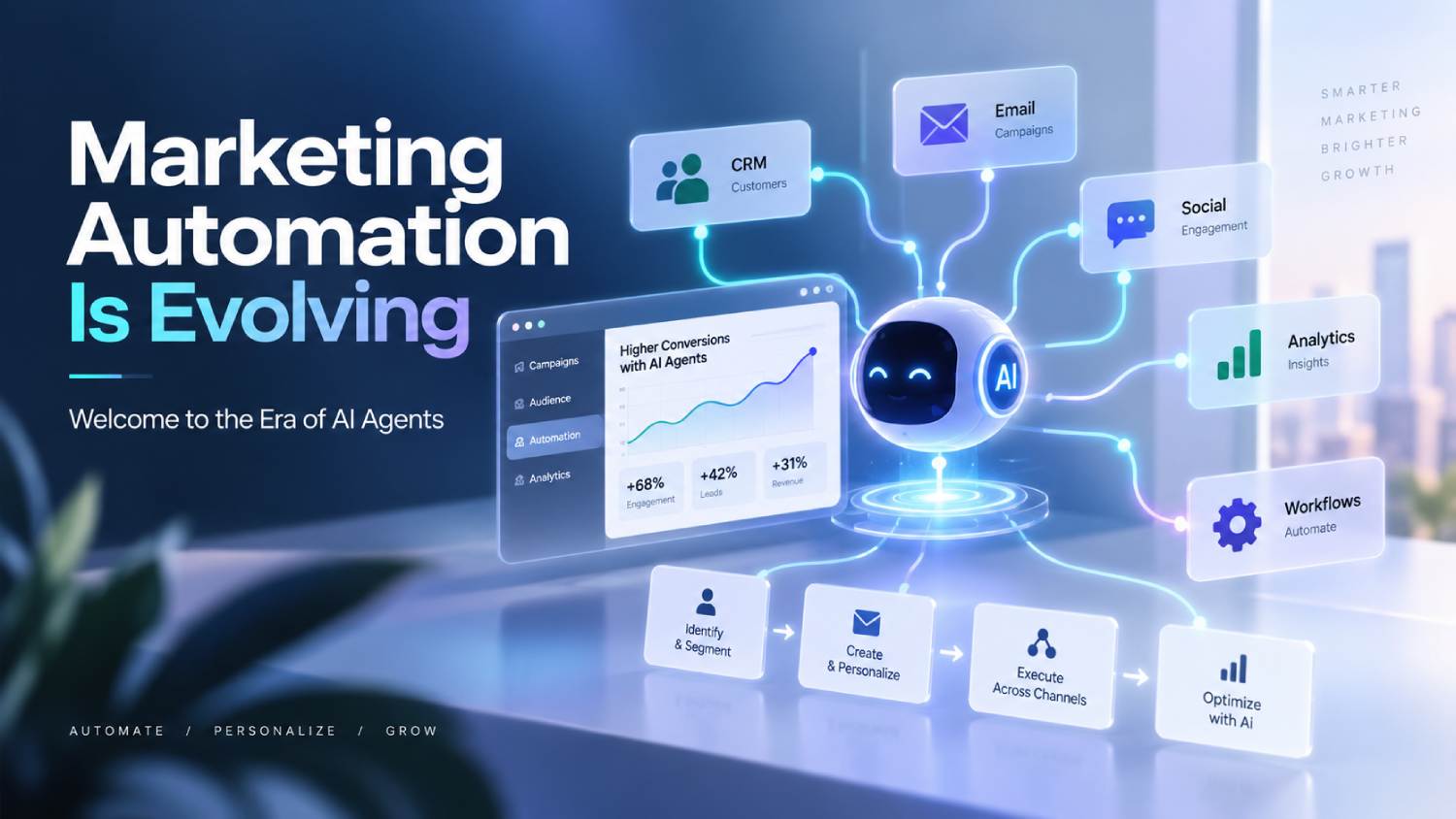
They can help analyse leads, personalise customer communication, monitor campaign performance, organise CRM data, prepare reports, and recommend the next best action.
For example, instead of every lead receiving the same email sequence, an AI agent could recognise that one customer is ready to speak with sales while another still needs more information.
This makes marketing less dependent on fixed journeys and more responsive to actual customer behaviour.
More Than Just Another AI Chatbot
Most businesses already use AI to write captions, draft emails, summarise reports, or generate ideas.
AI agents go a step further.
A chatbot may respond to:
“Write a follow-up email.”
An AI agent could work on:
“Check today’s new leads, identify the most promising ones, prepare personalised follow-ups, and highlight who needs immediate attention.”
The value is not only in creating content.
It is in connecting analysis, decision-making, and action.
A Smarter Customer Journey
Customers rarely follow one perfect path.
One person may open every email. Another may only respond on WhatsApp. Someone else may repeatedly visit a product page before finally making a purchase.
Traditional automation needs different rules for every possible situation.
AI agents can help businesses respond more dynamically by understanding what the customer is doing and suggesting the most relevant next step.
That could make customer journeys more personalised without requiring marketers to manually build dozens of complicated workflows.
The Marketer Still Leads
AI agents do not remove the need for marketers.
They change where marketers spend their time.
Instead of constantly managing repetitive tasks, marketers can focus more on strategy, creativity, customer understanding, brand positioning, and campaign direction.
The future may look less like:
Marketer + Automation Tool
and more like:
Marketer + Automation + AI Agents
The marketer remains responsible for the goal. AI helps with the execution.
Smart Automation Still Needs Guardrails
More intelligent automation also means more responsibility.
Businesses need to decide what AI is allowed to do automatically and what still needs human approval.
An AI agent may be allowed to analyse leads or draft emails, but a company may still want approval before messages are sent, budgets are changed, or important customer decisions are made.
The best AI automation will not be the one with the least human involvement.
It will be the one with the right balance between AI autonomy and human control.
What This Means for Businesses
Businesses do not need to replace every automation workflow with AI.
Simple tasks will still work perfectly with traditional automation.
The real opportunity is in workflows where someone currently needs to:
check information → understand the situation → decide what to do → take action.
That is where AI agents can add the most value.
Lead qualification, CRM management, customer follow-ups, campaign monitoring, reporting, and personalisation are strong places to start.
Automation Is Becoming Smarter
Marketing automation was originally built to save time.
AI agents are taking it toward something bigger.
The question is no longer only:
“What task can we automate?”
It is becoming:
“What decision can AI help us make better?”
The next era of marketing automation will not be about removing humans from marketing.
It will be about combining human strategy, reliable data, automation, and AI agents to build faster and more intelligent marketing systems.
Automation isn’t disappearing. It’s becoming intelligent.