
The Customer Journey Has Changed, Has Your Marketing Strategy?
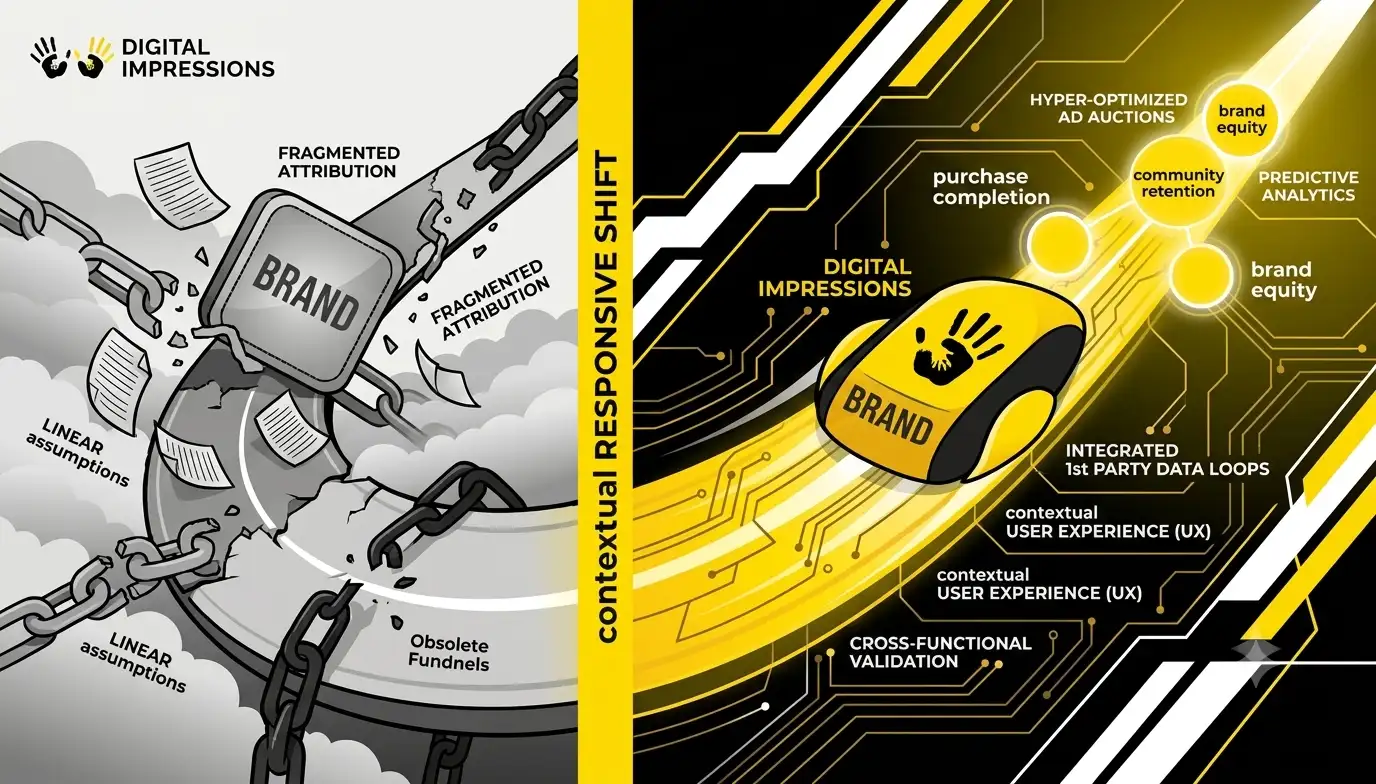
The traditional marketing funnel is dead, yet its ghost continues to dictate the capital allocations of legacy brands worldwide. For decades, corporate marketing departments operated under a beautifully simple, linear assumption: awareness led to consideration, consideration advanced to intent, and intent seamlessly finalised into a transaction. It was a neat, predictable assembly line where you pushed a prospect in at the top and caught a customer at the bottom.
But in a decentralised digital ecosystem driven by immediate mobile touchpoints, contextually responsive AI search matrices, and continuous algorithmic curation, this clean path has shattered into complete chaos. Modern consumers do not move in neat, downward lines; they loop, skip, backtrack, and evaluate multiple spaces simultaneously. The brands that continue to execute strategies built for a static, linear journey are effectively funding an obsolete map, wasting precious acquisition resources trying to force fluid customer behaviours into a rigid, legacy cage.
This profound shift marks the era of the cyclical, behaviour-driven user experience. Attention is no longer a permanent commodity that can be bought once and exploited indefinitely; it is a highly transient, real-time signal that must be captured and validated at every single touchpoint. If your digital storefront UX is slow, your attribution infrastructure is fragmented, and your message fails to adapt instantly to a user’s active intent, the modern consumer will exit your ecosystem within a single click. Ad delivery algorithms do not reward legacy persistence; they reward transactional fluidity, data precision, and instant relevancy. Welcome to the new reality of commerce where you either build a contextually adaptive marketing engine that mirrors the complex consumer loop, or you watch your conversion metrics steadily collapse into complete market irrelevance.
1. The Shattered Funnel: Analyzing the Modern “Messy Middle”
To understand why modern campaigns stall despite massive media budgets, one must dismantle the structural illusion of the linear funnel. In the legacy digital environment, a consumer encountered a problem, used a basic search string to find a provider, browsed a static product catalogue, and completed a checkout. Because choices were limited and discovery paths were uniform, marketing teams could easily map out a uniform sequence of ad exposures and predict market returns.
Today, that simple pathway has been replaced by what industry analysts call the “messy middle”a complex, unpredictable space of exploration and evaluation between trigger and purchase. A modern consumer might discover a lifestyle brand on an organic social reel, instantly cross-reference consumer reviews on a global marketplace, read a highly technical comparison blog via an AI search summary, leave the site to check their cash constraints, and finally execute the purchase three weeks later through a targeted remarketing ad on an entirely different platform. They drift seamlessly between organic discovery, paid media hooks, and independent validation loops, ignoring the pre-planned boundaries of traditional campaign mapping.
When a brand relies on a legacy strategy, it treats these fluid transitions as isolated events. The creative team designs generic messaging for broad awareness, while the media buying team runs performance ads without checking if the post-click storefront matches the incoming user context. This operational disconnect introduces severe friction into the messy middle. When a consumer experiences a jarring gap between a personalised ad hook and a rigid, slow storefront destination, they abandon the path instantly. The lesson is clear: your marketing framework cannot survive if it treats a dynamic, non-linear journey as a collection of static milestones.
2. The DI Architecture: Engineering Contextual User Journeys
At Digital Impressions (DI), we recognised that surviving this behaviour-driven market shift required completely re-imagining how digital architecture responds to consumer intent. We eliminated the old boundaries separating technical infrastructure from creative execution. It’s not just AI; it’s the DI Effect. We don’t just give a prompt; we are prompt. We developed an integrated pre-launch engineering framework that aligns every digital touchpoint from high-yield performance media variants to advanced enterprise storefront hierarchies into a singular, highly responsive conversion engine.
Adapting to the modern customer journey requires absolute data precision at the development layer. Whether optimisation leads scale a premium D2C textile presence or configure high-performance marketplaces for home and kitchen appliances, DI builds clean first-party data loops directly into the custom code. We use advanced predictive analysis to map out the exact paths users take through the messy middle, ensuring the target storefront automatically balances its visual layout to match incoming search variables. We deploy deep microdata schemas, maximise cross-platform server load velocities, and build clean user journeys that feel organic to the consumer. We replace speculative planning with absolute empirical proof, ensuring your digital property is engineered to convert intent at the exact millisecond it manifests.
The Non-Linear Journey Alignment Matrix
| Journey Matrix | The Obsolete Linear Model | The DI Contextual Engine (The DI Effect) |
|---|---|---|
| Intent Capture | Broad keyword targeting driving users to generic home or category pages. | Deep semantic entity recognition routing intent to hyper-optimised, adaptive layouts. |
| User Experience (UX) | Static desktop layouts forced mechanically into standard responsive mobile viewports. | Ultra-fast, mobile-first architectures engineered to eliminate navigation drag instantly. |
| Data & Attribution | Legacy pixel configurations yielding fragmented, unverified attribution loops. | Clean, verified first-party data pipelines feeding optimisation signals to ad networks. |
| Creative Integration | Isolated ad assets disconnected from the transactional destination environment. | Continuous narrative consistency mapping visual hooks smoothly to checkout completion. |
The Non-Linear Journey Alignment Matrix
3. The Mechanics of Algorithmic Attribution Friction
To appreciate the cold mathematics behind modern funnel collapse, one must analyse the penalties ad platforms impose on broken technical frameworks. Today’s deep-learning auction engines (across Meta, Google, and TikTok) operate as high-velocity pattern-recognition systems. They evaluate user behaviour data streams in real time to decide which ads deserve priority distribution. When your conversion tracking is clean and accurate, the platform’s engine self-corrects to locate high-converting audience segments with surgical accuracy.
However, if your customer journey spans multiple channels but your site data is fragmented, the optimisation loop breaks completely. The auction engine registers a user bounce or an abandoned cart but receives no clean behavioural signals to understand why. It interprets this data gap as poor user experience, applies an immediate quality penalty to your account, and drives up your acquisition costs. At Digital Impressions, we completely eliminate this invisible threat. Our 360-degree performance marketing strategies align paid media buying, technical SEO optimisation, and social curation into a singular, integrated data pipeline, feeding clean programmatic tracking data back into the networks to maximise your overall return on ad spend (ROAS).
4. Striking the Essential Equilibrium: Creative Mastery Guided by Analytical Truth
Does mapping a data-driven, non-linear journey mean that authentic human creative execution is no longer important? The exact opposite is true. In an automated marketplace where machine learning systems can instantly generate basic layouts and cookie-cutter ad copy variants, pure technical setup becomes a commoditised metric. True competitive advantage shifts back to high-end human artistry, curated brand storytelling, and absolute aesthetic authority.
An algorithm can easily calculate click-through efficiencies, but it cannot create a distinct brand soul. It cannot understand the subtle emotional pull of a “quiet luxury” visual identity, select a modern serif typeface that balances artisanal craft with clinical precision, or design a clean layout that conveys premium quality to international markets. The data pipeline must handle tracking, but human vision must dictate the creative standard that wins long-term customer equity.
At Digital Impressions, our elite design and strategy teams collaborate directly with our web engineers. We ensure that while your backend systems are perfectly tuned for automated indexing, your external user interface presents an unforgettable, premium brand experience. We build beautiful corporate identities, distinctive lifestyle storefronts, and high-converting e-commerce assets that build true customer trust across competitive global business hubs like New Delhi, Dubai, Riyadh, and Doha. We turn casual web traffic into long-term brand equity by combining data precision with human artistry.
5. The Compounding Penalty of Legacy Isolation
The speed gap separating highly responsive, data-driven brand architectures from siloed corporate legacy structures is expanding rapidly. Organisations that resist building an adaptive customer journey face a compounding loop of diminishing returns. They waste months of valuable internal team hours debating generic campaign hooks in isolated silos, only to watch their market execution stall due to missing track variables, sluggish backend systems, and disjointed cross-channel messaging.
Conversely, a brand that utilises a unified pre-launch validation model experiences zero drag. Because their technical protocols, data attribution channels, and creative content strategies are locked into a single loop, they can spot user trends and shift campaign directions in near real time. Their human teams are liberated from routine administrative monitoring, allowing them to focus entirely on improving product quality, mapping customer behaviour shifts, and designing disruptive creative concepts. In the modern market, staying static is the ultimate commercial risk.
6. Mastering the New Journey: A Strategic Action Framework
Re-engineering your brand’s digital ecosystem to thrive within the non-linear customer journey requires making absolute changes to your launch workflow. To shield your marketing capital from cross-functional friction, execute this blueprint immediately:
Deploy Server-Side Tracking Architectures: Replace outdated browser-dependent cookies with secure, verified first-party server pipelines. Ensure every user milestone within the messy middle is accurately captured and passed back to ad engines without data drop-offs.
Unify Ad Variations With Dynamic Landing Layouts: Eliminate the generic landing page experience. Ensure that the specific visual hook, tone of voice, or product parameter that captures a click matches the destination layout’s structure, preserving absolute narrative consistency.
Execute Continuous Cross-Functional Audits: Break down the barriers between your performance media managers and web development leads. Never allow a creative campaign to receive formal budget allocation until its destination platform has been technically stress-tested for speed, schema logic, and mobile checkout efficiency.
The rules governing digital growth leave no room for operational drag. The era of launching broad-stroke campaigns on a wave of pure intuition and separate workflows has passed, replaced by a sophisticated commercial landscape driven by data precision, structural validation, and absolute platform integration. As the digital market completes this evolution, your leadership team faces a definitive operational choice: do you continue running your brand on fragmented legacy habits, or do you step forward with a partner that builds for absolute digital survival?
Take a critical look at your current acquisition metrics, check your platform drop-off rates, and audit your cross-functional development pipelines. Is your marketing strategy engineered to dominate the complex, modern customer journey, or are you financing legacy, disconnected processes that dilute your margins before the consumer ever reaches checkout? If your current agency footprint is not delivering real structural efficiency, let’s transform your trajectory. Contact Digital Impressions today, and let’s deploy the DI Effect to engineer your market dominance from the ground up.
As the algorithmic marketplace systematically filters out linear strategies, a definitive question stands before your brand: When your next major campaign enters the digital auction arena, will your platform adapt seamlessly to the fluid consumer loop, or has your strategy already failed because it was built for a journey that no longer exists?
You might also like

The Impressions Edit – September ’26

Expert Insights: How AI Is Changing E-commerce Marketing
Marketing Automation Is Evolving: Welcome to the Era of AI Agents

AS SEEN ON









awards


Excellence
in Digital Marketing

Women CPO
of the year 2023

Transformational
Leaders to Watch

Most Trusted
Companies


-

UAE
DUBAI, UAE
+971-545502300 Digital Impressions (FZCO)
72819, IFZA Business Park, A1,
Dubai Silicon Oasis - 342001
UAE

-

INDIA
NCR
+91-9811348433 Digital Impressions (INDIA)
29-36 LGF, Charmwood Plaza,
Delhi NCR - 121009
India
-

INDIA
GURUGRAM
+91-9811348433 Digital Impressions (INDIA)
4th Floor, JMD MEGAPOLIS, FF-402,
Badshahpur Sohna Rd, Sector 48,
Gurugram, Haryana 122018
India
-

USA
ATLANTA, GEORGIA
Digital Impressions (USA)
1445 Woodmont Ln NW,
4515 Atlanta Georgia - 30318
United States


