Top Payment Gateways in UAE for eCommerce Websites: Fast, Secure Online Transactions
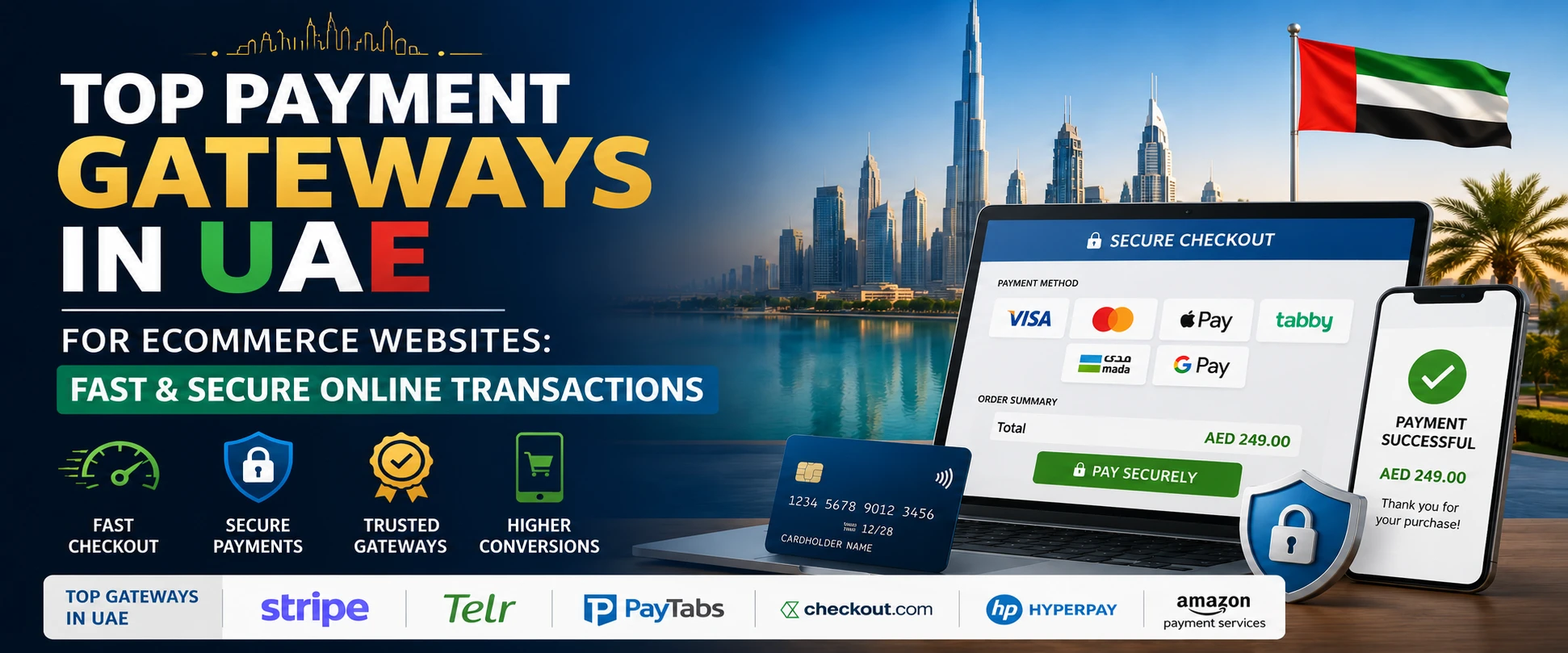
Running an eCommerce store in the UAE is exciting — but losing a sale at the very last step because of a poor payment experience? That is genuinely painful. UAE shoppers are among the most digitally savvy in the world. They expect fast, smooth, and secure checkouts. If your payment gateway lets them down, they will not come back. Choosing the right payment gateway is not just a technical decision — it directly affects your revenue, your customer trust, and your brand reputation in one of the most competitive online markets in the region.
Table of Contents
What is a Payment Gateway?
A payment gateway is the digital tool that securely moves money from your customer’s bank to yours when they shop online. It encrypts card details, checks for fraud, gets bank approval, and confirms the transaction — all within seconds. Without it, online selling simply is not possible.
Types of Payment Gateways
Not every gateway works the same way. Here is a quick breakdown of the four main types so you can decide which setup suits your store best.
1) Hosted Payment Gateways
The customer is redirected to the gateway provider’s secure page to complete payment, then brought back to your site. This is the easiest type to set up because the provider handles all security and compliance for you. You do not need to worry about storing card data or managing PCI requirements yourself. It is the most popular choice for new UAE eCommerce businesses. The small downside is that the customer briefly leaves your website, but most shoppers do not mind when the page looks professional and trustworthy.
2) Self-Hosted Payment Gateways
Here, the payment form lives directly on your website. Customers never leave your domain, which creates a fully branded, seamless checkout experience. You control every detail of the design and flow. However, because payment data passes through your own servers, you are fully responsible for PCI DSS compliance and security — which requires a strong technical team. Best suited for established UAE brands with the resources to manage it properly.
3) API-Hosted Payment Gateways
This type gives you the best of both worlds. The checkout form appears on your website, but sensitive card data is handled securely by the gateway’s servers through an API. Customers stay on your site throughout, and you are not carrying the full security burden alone. Integration requires developer involvement, but the result is a smooth, professional, on-site payment experience. Stripe and Checkout.com are strong examples of this type.
4) Local Bank Integration Gateways
These connect your store directly to a UAE bank’s payment system — Emirates NBD, FAB, or ADIB, for example. Because there are fewer intermediaries, transaction fees are often lower. However, the features are more basic — limited payment methods, fewer integrations, and minimal global reach. This works well for businesses that serve a purely local UAE audience and process straightforward card transactions at high volumes.
Top Payment Gateways in UAE for eCommerce
1. Telr
Telr is one of the most established gateways built specifically for the UAE and GCC market. It operates in 120+ countries, supports Visa, Mastercard, Amex, and SADAD, and integrates with Shopify, WooCommerce, Magento, OpenCart, and PrestaShop. There is no setup fee, and monthly plans start from AED 99 — making it accessible for stores at any stage of growth.
2. Amazon Payment Services
Formerly known as Payfort, this gateway was built specifically for Arab consumers and remains one of the most trusted names in UAE eCommerce payments. It supports Arabic-language checkouts, understands local shopping behaviour, and is the go-to recommendation for UAE startups. Monthly fee is AED 200 with a 2.80% + AED 1.00 per transaction rate.
3. PayTabs
If you need your payment system live fast, PayTabs can have you up and running within 24 hours. It has strong fraud prevention, a built-in invoicing system, and supports Mada and STCPay alongside standard cards — making it ideal for UAE merchants also targeting Saudi shoppers. Integrates with Shopify, WooCommerce, Magento, and more.
4. Checkout.com
Built for scale. Checkout.com is the gateway of choice for UAE brands processing serious volumes who need advanced analytics, intelligent payment routing, and enterprise-grade security. Pricing is custom based on volume. If your store has grown beyond the startup phase and conversion optimisation matters, this is where you should look.
5. Hyperpay
Hyperpay is ideal for UAE merchants expanding across the GCC. With 100+ bank partnerships and support for Mada, STCPay, Apple Pay, Visa, Mastercard, and PayPal — all under one integration — it removes the need to juggle multiple gateways for different regional markets. Its real-time analytics dashboard is genuinely useful for tracking cross-border performance.
6. Stripe
Stripe is the top pick for tech-forward UAE eCommerce brands with developer resources. It supports Apple Pay, Google Pay, Buy Now Pay Later, subscriptions, multi-currency billing, and more. Its AI-powered fraud tool, Stripe Radar, is exceptionally effective. No monthly fees — just a straightforward per-transaction rate. Excellent for stores with a global or diverse customer base.
7. 2Checkout (Verifone)
The strongest option for UAE businesses selling digital products, online courses, or subscriptions. It covers 196 countries, 87 currencies, and 15 languages with zero setup or monthly fees. You only pay per successful transaction, starting at 3.5% + $0.35. The FreshBooks accounting integration is a nice bonus for lean teams managing their own books.
8. Noon Payments
Built entirely around the UAE and GCC consumer. If your target audience is UAE nationals and residents already familiar with the Noon ecosystem, this gateway brings built-in local trust and strong regional optimisation. Still growing in terms of third-party integrations, but for local-first brands, the market credibility it carries is a real advantage.
9. Paycaps
Paycaps is the right choice if you want full control over your checkout’s look and feel. Its white-label solution lets you customise everything — design, payment methods, themes — so your customers never feel like they have stepped outside your brand. Strong multi-currency support and chargeback management make it a smart pick for high-ticket UAE stores.
10. PayPal
PayPal is not the primary payment method for most UAE residents shopping locally, but it is essential if your store serves international customers. European, North American, and South Asian buyers trust it instinctively. No monthly fees, integrates with everything, and significantly reduces checkout drop-off among international buyers.
How to Pick the Right One for Your UAE Store
Starting out in Dubai or Abu Dhabi with your first store? Go with Amazon Payment Services or Telr. They are locally trusted, easy to set up, and built for UAE consumers from the ground up.
Scaling fast with a growing team? Checkout.com or Stripe will give you the infrastructure and analytics to match your ambition without hitting a ceiling.
Targeting customers across Saudi Arabia and the wider GCC? Hyperpay or PayTabs covers that regional spread under one integration, saving you from managing multiple gateways simultaneously.
Selling digital products or running a subscription model? 2Checkout is made for exactly that — global reach, no monthly costs, and solid recurring billing support.
One honest tip — before you go live, test your own checkout on a real mobile device. Go through the entire payment flow as a customer would. If anything feels slow, unclear, or off-brand, your customers will feel it too. Fix it before they do.
Final Note
Your payment gateway is the last handshake between your store and your customer. Everything before it — your ads, your product pages, your offers — only matters if that final step goes smoothly. In the UAE’s eCommerce market, where expectations are high and competition is intense, a reliable and locally-optimised payment gateway is not optional. It is the foundation your sales are built on. Choose it carefully, test it thoroughly, and revisit the decision as your business grows.
Frequently Asked Questions
1. Which payment gateway is best for a new UAE eCommerce store?
Amazon Payment Services and Telr are the top recommendations for new stores in the UAE. Both are purpose-built for the local market, easy to set up, and widely trusted by UAE consumers.
2. Do I need a UAE trade licence to use a payment gateway?
Yes. All payment gateways operating in the UAE require a valid trade licence and a UAE corporate bank account during merchant onboarding. This is a Central Bank of UAE requirement.
3. Can I use multiple payment gateways on one store?
Yes, many UAE stores do this — typically one for local card payments and PayPal for international customers. It adds some technical complexity but improves coverage for diverse audiences.
4. What transaction fees should I expect in the UAE?
Most UAE gateways charge between 2.5% and 3.5% per transaction plus a small fixed fee. Gateways with no monthly fees tend to have slightly higher per-transaction rates.
5. Do UAE payment gateways support Arabic checkout?
Several do, including Amazon Payment Services, Telr, Hyperpay, and PayTabs. If your audience includes Arabic-speaking shoppers, Arabic checkout support should be a non-negotiable requirement.
6. Why are some international gateways not available in the UAE?
The Central Bank of UAE requires payment service providers to hold specific regulatory approvals to operate legally in the country. Gateways without UAE licensing cannot process transactions for UAE-registered merchants.