
Expert Insights: How AI Is Changing E-commerce Marketing
For most of the last two decades, e-commerce marketing ran on the same playbook: rank on Google, run paid search and social, build an email list, optimize the funnel. That playbook hasn’t died. It’s just stopped being enough on its own.
Here’s the actual shift: shoppers are asking AI assistants what to buy instead of typing into a search box. Algorithms decide which product they see first. Every touchpoint- search, ads, email, support- is expected to already know who they are. In India specifically, 41% of consumers are already using AI-driven shopping tools, and another 40% say they’re about to, according to Capgemini’s 2026 research – the highest adoption of any market in that study. This isn’t an early-adopter curiosity. It’s just how people shop now.
I don’t think that makes marketing expertise less valuable. If anything, it makes bad marketing more obvious. AI raises the floor for what “good” looks like, and it doesn’t forgive brands that never had a real strategy to begin with, just a set of tactics that happened to work while the playing field was flatter.
How AI Is Changing E-commerce Marketing
At a high level, AI is compressing timelines and expanding what’s possible across the entire marketing function:
- Faster, data-driven decision-making instead of quarterly reporting cycles
- Deeper customer insight drawn from behavioural and transactional data
- Personalised experiences delivered at a scale no human team could manage manually
- Automated workflows for campaigns, content, and customer communication
- Smarter, more intuitive product discovery
- Conversational shopping that replaces multi-page browsing
- Predictive analytics that anticipate customer needs rather than just reporting on them
- More efficient advertising and content production
The common thread is that AI isn’t adding a new marketing channel — it’s changing how every existing channel operates.
AI-Powered Personalization Is Changing the Customer Experience
Personalization doesn’t need new data to work – that’s what makes it the AI use case that’s actually paying off. Brands are just finally using what they already had sitting in a database: purchase history, browsing behavior, search queries, what people click on, where they’re shopping from, how often they buy. The technology changed. The inputs didn’t.
What’s changed is the ability to act on those signals in real time, across every customer-facing surface — product recommendations, offers, email content, on-site experiences, and retargeting campaigns. E-commerce leaders consistently rank personalization among the top shopper-facing AI applications, and the revenue case backs that up: businesses using AI-driven personalization report meaningfully higher revenue than those without it, largely through improved discovery, higher conversion, and stronger customer lifetime value (HelloRep, 2026). Consumer expectations have shifted accordingly — the majority of shoppers now say they’re more likely to buy from brands that get personalization right.
AI Is Transforming Product Discovery and E-commerce Search
This is arguably the most important shift happening right now.
Search behaviour is moving along a clear path: keyword-based search → semantic search → conversational discovery → AI-assisted shopping. Instead of typing “women’s beach dresses,” a shopper is increasingly likely to ask, “What should I wear for a beach vacation in Goa?” — and expect a genuinely useful, context-aware answer.
This shift shows up across several layers of the shopping experience:
- AI-powered site search that understands intent, not just keywords
- Semantic search that matches meaning rather than exact phrasing
- Visual search that lets shoppers search with an image instead of words
- Conversational product discovery through chat-based assistants
- AI shopping assistants that compare, filter, and recommend on a customer’s behalf
- AI search and answer engines that surface product answers directly, without a click-through
This is also where Answer Engine Optimization (AEO) and Generative Engine Optimization (GEO) enter the picture — the practice of making a brand legible and citable to AI systems, not just visible in traditional search rankings.
From Google Search to AI Search: A New Visibility Challenge for E-commerce Brands
Product research is moving off the search results page entirely. Google’s AI experiences, ChatGPT, Gemini, Perplexity, built-in shopping assistants — that’s where a lot of discovery happens now. Adobe’s 2026 data shows generative-AI traffic to retail sites climbing by triple and quadruple digits year over year, and in some categories it’s closer to 1,000%.
Most brands haven’t noticed yet. AI systems don’t browse a site the way a person does. They read product data, category pages, FAQs, reviews, structured markup, and whatever’s been said about the brand elsewhere. Thin or inconsistent content, and the brand just doesn’t get mentioned — it doesn’t matter how well it ranks on Google. I’d stop calling this an SEO extension. It’s a separate channel with its own rules, and brands that treat it as an afterthought are going to be invisible to the exact assistants their customers are now asking for recommendations.
How AI Is Making E-commerce Advertising More Intelligent
Paid media has moved a long way from manually built campaigns and static audience lists. AI now plays a central role in:
- Audience segmentation based on behavioural and intent signals
- Automated bidding that adjusts in real time
- Creative variations generated and tested at scale
- Predictive targeting that identifies high-intent shoppers earlier
- Campaign optimisation across channels and formats
- Product recommendations embedded directly into ad creative
- Dynamic advertising personalised to the individual viewer
- Customer-value prediction that informs how much to spend acquiring a given customer
The practical shift for marketers is one of role, not relevance: instead of manually managing every bid and audience segment, the job becomes defining strategy, feeding the system clean data, and guiding AI-assisted optimisation toward the right business outcomes — not just the easiest ones to automate.
AI Is Changing Content Marketing for E-commerce Brands
AI can meaningfully speed up content production — product descriptions, blog ideation, content briefs, ad copy variations, email campaigns, social content, SEO research, and content personalisation are all faster with AI in the workflow.
But there’s an important caveat: AI-generated content alone does not create authority. Brands still need first-hand expertise, a consistent brand voice, original insight, careful human editing, accurate product information, experience-based content, and genuine trust signals. This lines up closely with Google’s E-E-A-T principles – Experience, Expertise, Authoritativeness, and Trustworthiness- which increasingly separate content that performs from content that simply exists. AI is best treated as a production accelerant, not a substitute for expertise.
Predictive Analytics: Moving from Reactive to Proactive Marketing
Where traditional analytics explains what already happened, predictive analytics helps brands prepare for what’s likely to happen next — identifying:
- Which customers are likely to purchase soon
- Which customers are showing early churn signals
- Which products are likely to perform well
- When customers are likely to reorder
- Which audiences carry the highest lifetime value
- Which campaigns are likely to outperform others
Used well, this turns marketing from a series of reactive campaigns into a system that anticipates customer behaviour ahead of time — informing everything from inventory and email timing to which customers get proactive retention outreach.
AI-Powered Customer Service and Conversational Commerce
AI has also reshaped customer service, powering chatbots, product recommendation assistants, order-status handling, FAQ resolution, size and fit guidance, cross-selling and upselling prompts, and round-the-clock support availability.
This feeds directly into conversational commerce – a shopping model where customers interact with a brand through natural language rather than navigating multiple pages, filters, and menus. For high-consideration categories like fashion and lifestyle, that shift is particularly significant, since AI adoption for fashion research and sizing guidance is already meaningfully changing how Indian shoppers evaluate fit and confidence before buying (First Resort / BCG, 2026).
AI and Retention Marketing: Creating More Relevant Customer Journeys
Retention marketing has moved from broad, one-size-fits-all campaigns to behaviour-based communication, powered by AI across:
- Email segmentation based on real engagement and purchase signals
- WhatsApp campaigns tailored to individual customer stages
- Abandoned-cart journeys sequenced by intent, not just time elapsed
- Post-purchase communication that adapts to product and customer type
- Replenishment reminders timed to actual usage patterns
- Loyalty campaigns built around behaviour, not just tenure
- Win-back campaigns targeted at customers showing early churn signals
The net effect is a shift from mass marketing to something closer to one-to-one communication, delivered at a scale that would be impossible to manage manually.
What AI Cannot Replace in E-commerce Marketing
None of this makes marketers optional — and framing AI as a replacement for expertise misreads what’s actually happening. AI can process information at scale, but strategy still requires context, and context is where human judgement remains essential:
- Human creativity in campaign concepts and storytelling
- Brand positioning that reflects a genuine point of view
- Strategic thinking that connects marketing decisions to business goals
- Deep customer understanding that goes beyond behavioural data
- Business judgement about trade-offs AI can’t weigh on its own
- Emotional storytelling that builds real brand affinity
- Relationship building with customers, partners, and platforms
- Ethical decision-making around data use, messaging, and transparency
Brands that treat AI as a replacement for these things tend to produce marketing that’s fast but forgettable. Brands that treat it as a force multiplier for good strategy tend to pull ahead.
The Human + AI Approach to E-commerce Growth
The strongest e-commerce strategies aren’t built on AI alone — they combine AI, data, technology, and human expertise. AI is most valuable not as a replacement for experienced marketers, but as a tool that helps them make faster, better-informed decisions across personalization, discovery, advertising, content, and retention.
Digital Impressions: Bringing 17+ Years of E-commerce Experience to the AI Era
17+ Years of Understanding How E-commerce Businesses Grow
Digital Impressions has spent 17+ years working across the e-commerce ecosystem — store development, acquisition, retention, search visibility, creative, analytics, and optimisation — across 100+ e-commerce projects. That includes deep, hands-on experience with fashion, lifestyle, and D2C businesses, and with the platforms – Shopify chief among them— that power modern e-commerce storefronts. Just as important, it means genuinely understanding both the technology stack and the marketing strategy layered on top of it, rather than treating them as separate disciplines.
AI-Powered Strategies Built on Real E-commerce Experience
AI tools are only as good as the strategy directing them. Applied well, they’re most effective when combined with real business understanding, first-party customer data, SEO expertise, performance marketing knowledge, conversion optimisation experience, and creative strategy — the same capabilities that mattered before AI, now amplified by it.
Connecting Store, Marketing, Search and Retention
Digital Impressions’ approach is built around an integrated growth system rather than isolated services – spanning store and conversion, paid growth, search visibility, creative and social, retention, and analytics- working together rather than operating as disconnected workstreams.
Why Experience Matters in an AI-Driven E-commerce Landscape
This is where experience earns its keep. Years of e-commerce work help answer the questions that actually determine whether AI investment pays off:
- Where should AI actually be implemented, and where would it be a distraction?
- Which processes are genuinely worth automating?
- What data should be feeding these systems — and is it clean enough to trust?
- Where does human expertise remain essential, regardless of what the technology can do?
- How can AI improve conversion, rather than simply reducing workload?
- How should brands prepare for AI-driven product discovery specifically?
These aren’t questions a tool can answer on its own. They require the kind of judgement that comes from having run e-commerce growth strategies long before “AI-powered” was a category on every agency’s homepage.
What E-commerce Brands Should Do to Prepare for an AI-First Future
A practical starting checklist:
- Strengthen first-party customer data.
- Improve product and category information.
- Invest in technical SEO and structured data.
- Optimise content for conversational search.
- Build strong brand authority and third-party mentions.
- Use AI for personalisation and automation, deliberately rather than everywhere at once.
- Test AI-assisted customer experiences before scaling them.
- Track AI-referred traffic and conversions as their own channel.
- Maintain human oversight of AI-generated content.
- Continuously test, measure, and optimise.
The Future of E-commerce Marketing: AI-Assisted, Not AI-Replaced
The competitive advantage in e-commerce won’t simply belong to brands that use AI — nearly all of them will, eventually. It will belong to brands that know where, when, and why to use it, and that pair the technology with genuine strategic experience rather than treating it as a shortcut.
That combination — technology, marketing, analytics, and strategy, applied by people who’ve done this for 17+ years — is exactly where Digital Impressions positions itself: as an experienced e-commerce partner helping brands navigate an AI-first landscape without losing sight of what actually drives growth.
Frequently Asked Questions
How is AI changing e-commerce marketing?
AI is changing e-commerce marketing by enabling greater personalization, smarter product discovery, automated campaign optimization, predictive analytics, conversational shopping, and more efficient content and customer-service workflows.
How can AI help e-commerce businesses increase sales?
AI can help identify high-intent customers, personalise product recommendations, optimise marketing campaigns, improve customer experiences, and automate retention activities — helping businesses create more relevant buying journeys.
Is AI replacing e-commerce marketers?
No. AI can automate repetitive tasks and analyse large amounts of data, but human expertise remains essential for strategy, creativity, brand positioning, customer understanding, and decision-making.
How does AI improve personalization in e-commerce?
AI can analyse customer behaviour and preferences to deliver more relevant product recommendations, content, offers, emails, and shopping experiences.
How is AI changing e-commerce SEO?
AI is expanding e-commerce SEO beyond traditional keyword rankings. Brands increasingly need clear product information, helpful content, structured data, authority, and content that can be understood across both traditional and AI-powered search experiences.
What is AI-powered product discovery?
AI-powered product discovery allows shoppers to find products through natural-language queries, recommendations, semantic search, visual search, and conversational shopping assistants.
How can Digital Impressions help e-commerce brands use AI?
Digital Impressions combines e-commerce development, performance marketing, search visibility, creative, retention, and analytics with AI-assisted approaches. With 17+ years of e-commerce experience, the agency focuses on connecting technology and marketing with measurable business outcomes.
Why choose Digital Impressions as an e-commerce marketing agency in India?
Digital Impressions brings 17+ years of experience in digital and e-commerce, with 100+ e-commerce projects and capabilities spanning Shopify, performance marketing, SEO, creative, retention, and analytics. The agency also identifies itself as a Shopify Partner and Google Partner.
For practical support, speak with the Digital Impressions team about the right next step for your e-commerce marketing and AI strategy.
You might also like
Marketing Automation Is Evolving: Welcome to the Era of AI Agents

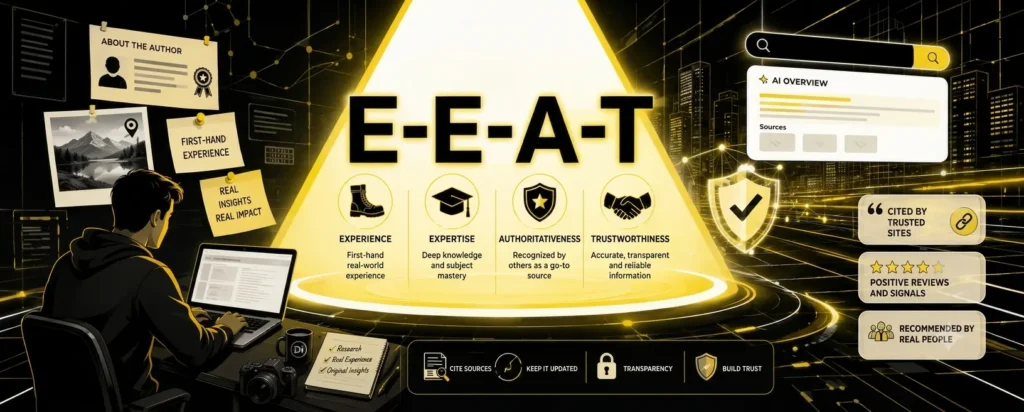
How E-E-A-T Helps Build Search Visibility and Trust

AS SEEN ON









awards


Excellence
in Digital Marketing

Women CPO
of the year 2023

Transformational
Leaders to Watch

Most Trusted
Companies


-


UAE
DUBAI, UAE
+971-545502300 Digital Impressions (FZCO)
72819, IFZA Business Park, A1,
Dubai Silicon Oasis - 342001
UAE

-

INDIA
NCR
+91-9811348433 Digital Impressions (INDIA)
29-36 LGF, Charmwood Plaza,
Delhi NCR - 121009
India
-

INDIA
GURUGRAM
+91-9811348433 Digital Impressions (INDIA)
4th Floor, JMD MEGAPOLIS, FF-402,
Badshahpur Sohna Rd, Sector 48,
Gurugram, Haryana 122018
India
-

USA
ATLANTA, GEORGIA
Digital Impressions (USA)
1445 Woodmont Ln NW,
4515 Atlanta Georgia - 30318
United States


