
How E-E-A-T Helps Build Search Visibility and Trust
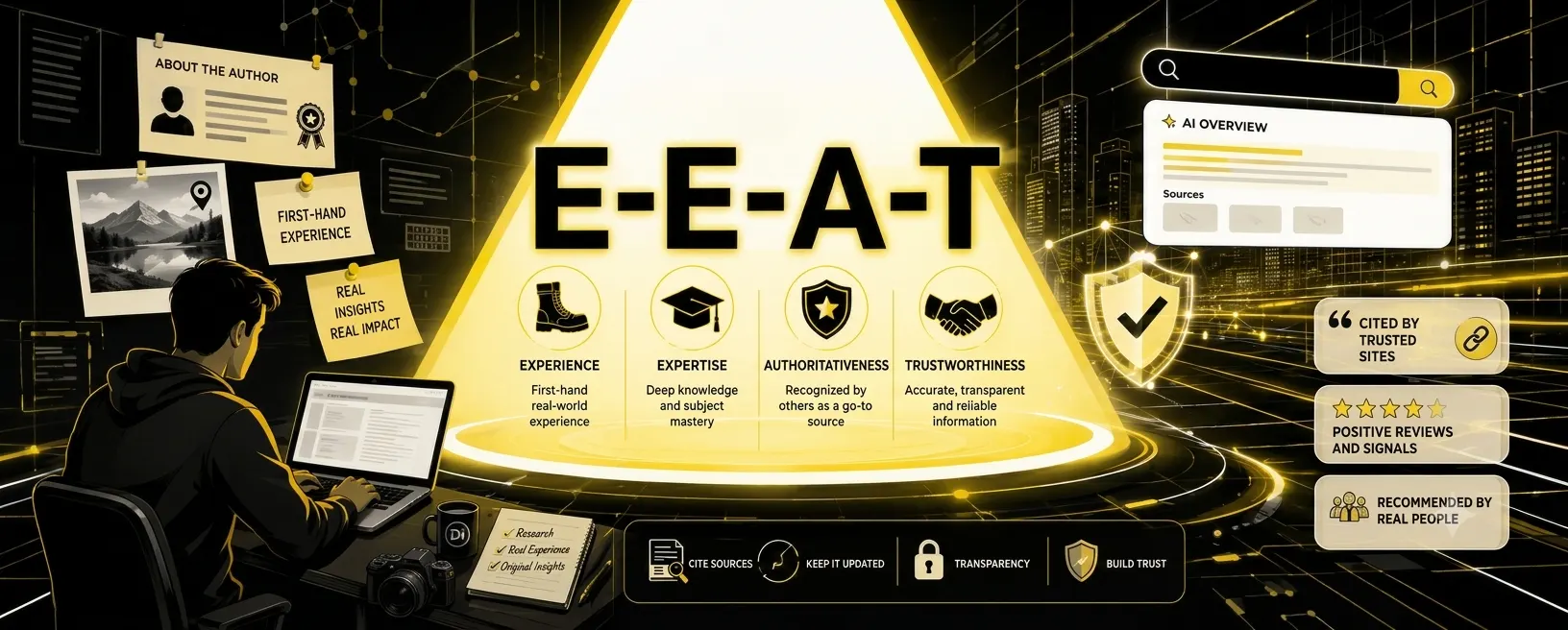
If you’ve read anything about SEO lately, you’ve probably run into E-E-A-T- Experience, Expertise, Authoritativeness, and Trustworthiness. It’s the framework Google’s Search Quality Raters use to judge what counts as “good” content. It’s not a ranking factor in the way page speed or backlinks are; Google doesn’t score it directly, but it feeds into a lot of what the algorithm ends up rewarding anyway.
If you write content for a seo, this isn’t really optional to understand at this point. I’ve seen plenty of well-optimized pages get buried simply because there was no real person or expertise behind them.
What Exactly Is EEAT?
EEAT isn’t a metric you check off in a dashboard. It’s four questions Google is quietly trying to answer every time it ranks a page.
- Experience: did whoever wrote this actually use the product, visit the place, live through whatever they’re describing?
- Expertise: do they know the subject cold, credentials or not?
- Authoritativeness: if you asked people in that field who to trust, would this site or author come up?
- Trustworthiness: is it accurate, and does it tell you where the information came from instead of just asserting things?
The Experience piece is the newest one. Google bolted it onto the older EAT framework in December 2022, and the timing tracks – that’s right around when search results started filling up with content that read fine on the surface but had clearly never been touched by anyone who’d actually done the thing. You can fake expertise pretty convincingly. It’s a lot harder to fake having been somewhere.
Why EEAT Matters for Search Visibility
Relevant isn’t enough anymore. Google wants to know a page can be trusted, and EEAT signals are how it tries to figure that out, especially on “Your Money or Your Life” topics. Health, finance, legal advice: the stuff where bad information can actually hurt someone, not just waste their time.
Here’s the thing about EEAT – it’s not just a Google buzzword; it actually moves rankings in a few real ways.
- Start with the raters. Google pays humans to score search results, and EEAT is literally the framework they use. That scoring becomes training data for the ranking algorithms. So when a rater looks at a page and can’t tell who wrote it or why they’d know anything about the topic, that judgment eventually shows up in how the algorithm treats similar pages at scale.
- Then there’s the behavioral stuff. Content written by someone who’s actually done the thing tends to just… answer the question better. People read more of it, leave less quickly. Those signals feed back into rankings, even if the connection is indirect.
- There’s a defensive reason too. No named author, no citations, nothing backing up the claims — those pages are the first to get flattened when a core update hits, especially in health and finance, where Google is genuinely paranoid about bad advice reaching people.
- And AI Overviews changed the calculus again. Those tools are pulling answers straight from the web and citing sources in real time, so they’re biased toward pages that already look credible, the same instinct as the human raters, just automated.
How EEAT Builds Trust With Your Audience
Search engines aside, EEAT matters because it mirrors what readers already want. Nobody trusts a page because it’s optimized. They trust it because it feels like a real person wrote it and actually knows the subject.
Real bylines help – a name, a bio, credentials, something that says an actual person is willing to stand behind this. First-hand material helps even more: original photos, screenshots, a case study, an anecdote that only makes sense if you were actually there. That stuff is nearly impossible to fake, which is exactly why it works.
Then there’s the boring-but-important part: linking to real sources, going back to fix things that are out of date. Not glamorous, but it’s the difference between a page someone’s maintaining and one that got published and abandoned. Same with the basics — contact info, a privacy policy, some sense of who’s actually running the place. Small stuff, but its absence is a tell.
Get this right, and people share the content, link to it, come back for more. Search engines are just trying to measure the same thing readers already feel.
How to Actually Move the Needle on EEAT
- Write real author bios. Actual credentials, experience – not “SEO enthusiast and content strategist.”
- Show your work. Original photos, your own data, the kind of detail a competitor can’t just copy-paste.
- Link out to sources you’d actually trust, not whatever’s sitting at the top of the SERP.
- Go back and fix your old posts. A 2021 stat in a page that claims to be current tells Google, and anyone reading closely, that nobody’s minding the store.
- Get mentioned by sites that already have earned trust. This is the slow one — no shortcut here.
- HTTPS, a privacy policy someone actually wrote, a phone number or inbox a human checks.
- Ask happy customers for reviews. Skip the incentivized or fake ones; Google’s gotten good at spotting the pattern.
None of it works as a one-time checklist. EEAT is more like a reputation than a score — built slowly across your bios, your content, your whole site, and just as easy to lose if you stop paying attention to any one piece.
Conclusion
EEAT isn’t something you bolt on before hitting publish; it’s really just a name for the stuff that was always true: did the person writing this actually know what they were talking about, and can you tell? Search is shifting toward AI-generated answers, and readers are getting sick of content that’s obviously mass-produced. Whether that shift helps or hurts you probably comes down to one thing — whether you can show you actually did the work, not just wrote about it.
Frequently Asked Questions
Is EEAT a direct Google ranking factor?
No. EEAT is a quality framework used in Google’s Search Quality Rater Guidelines. It doesn’t directly determine rankings but influences the signals and algorithms that do.
What’s the difference between EAT and EEAT?
EAT (Expertise, Authoritativeness, Trustworthiness) was the original framework. Google added “Experience” in 2022 to emphasize first-hand, real-world knowledge in content evaluation.
Does EEAT matter for all types of content, or just YMYL topics?
It matters most for YMYL (Your Money or Your Life) content like health, finance, and legal advice, but it applies to all content since trust and quality benefit every niche.
Can small websites or new creators build strong EEAT?
Yes. Authentic experience, clear author credentials, and accurate information can help even smaller sites build credibility over time, though it typically takes consistent effort.
How does EEAT relate to AI-generated content?
AI-generated content can struggle with the “Experience” pillar since it lacks first-hand knowledge. Human review, added expertise, and genuine insights help bridge that gap.
How can I check if my content reflects a strong EEAT?
Review your content for clear authorship, factual accuracy, credible sourcing, and evidence of real experience. Tools like author bio sections, citations, and updated publish dates all help signal EEAT.
You might also like

Best Shopify Agencies for Fashion Brands in Dubai & UAE

The Impressions Edit – September ’26

Expert Insights: How AI Is Changing E-commerce Marketing

AS SEEN ON









awards


Excellence
in Digital Marketing

Women CPO
of the year 2023

Transformational
Leaders to Watch

Most Trusted
Companies


-

UAE
DUBAI, UAE
+971-545502300 Digital Impressions (FZCO)
72819, IFZA Business Park, A1,
Dubai Silicon Oasis - 342001
UAE

-

INDIA
NCR
+91-9811348433 Digital Impressions (INDIA)
29-36 LGF, Charmwood Plaza,
Delhi NCR - 121009
India
-

INDIA
GURUGRAM
+91-9811348433 Digital Impressions (INDIA)
4th Floor, JMD MEGAPOLIS, FF-402,
Badshahpur Sohna Rd, Sector 48,
Gurugram, Haryana 122018
India
-

USA
ATLANTA, GEORGIA
Digital Impressions (USA)
1445 Woodmont Ln NW,
4515 Atlanta Georgia - 30318
United States


